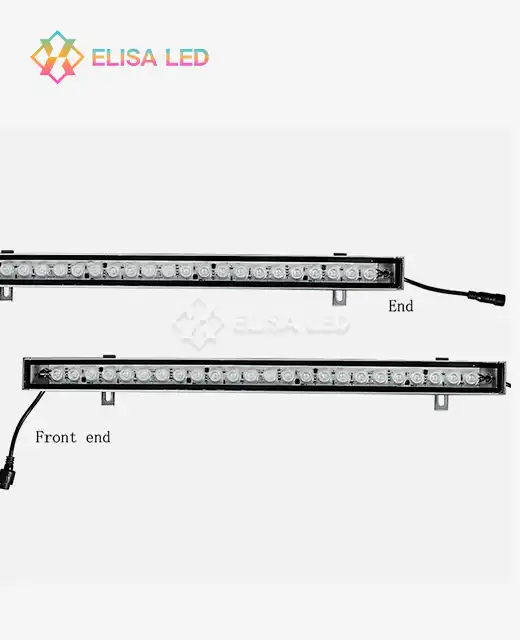
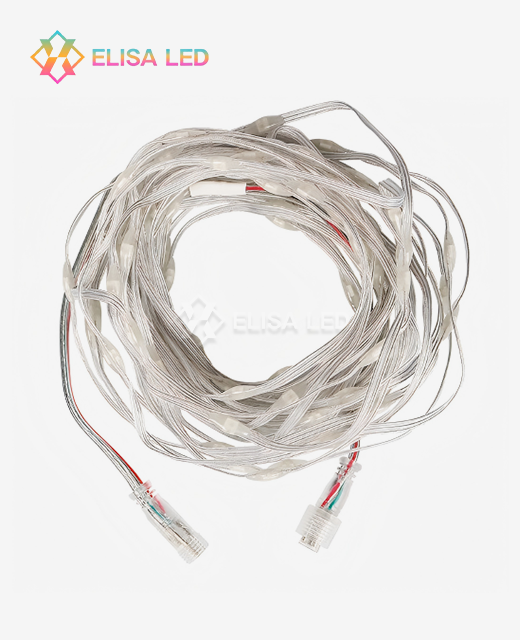
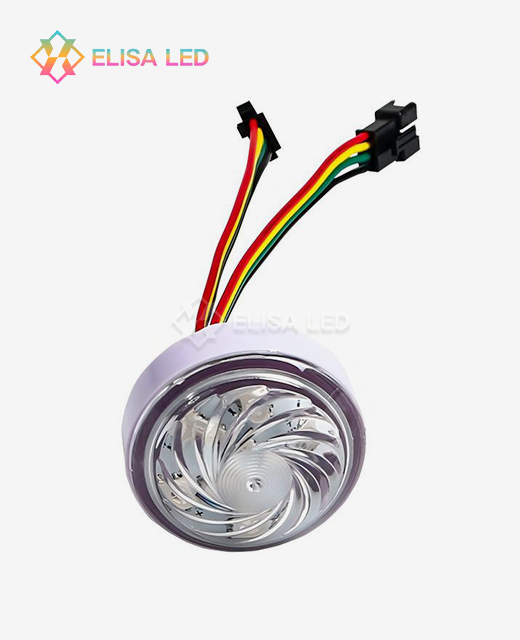
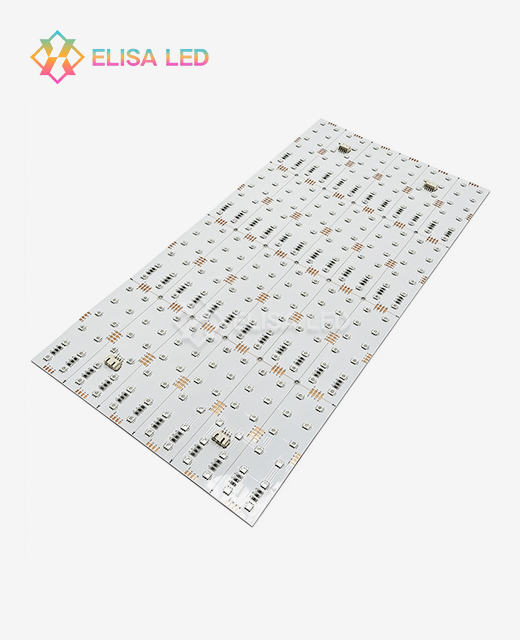
Without compromising brightness or colour accuracy, a flexible LED wall washer is a linear light that can be bent to follow curved walls, columns, bridges and building facades. When I specify lighting for curved façade projects on three separate continents, the five questions that always come up are bend radius, beam angle, IP rating, voltage, and control protocol. This document offers straightforward answers to all of the checklists I provide suppliers prior to approving a design. At the end, you will know exactly what to request and what to decline.
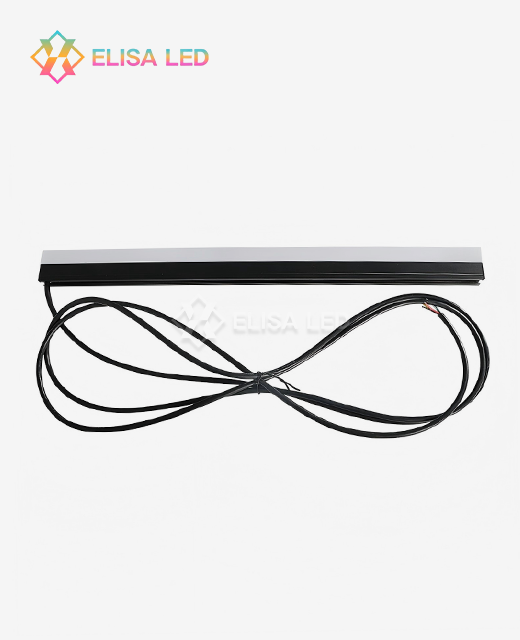
A "flexible LED wall washer" is a linear light fixture that can be twisted to evenly spread light over flat or curved surfaces. A row of LEDs and a lens that controls the light's dispersion are housed in a soft rubber sleeve. It is different from a typical LED strip since it has optics, a heat channel, and shielded end caps designed to work outdoors. Other dealers call it a wall grazer even though the equipment is the same.
There are LEDs on a flexible PCB, a silicone housing, a lens for diffusing or focusing light, waterproof end caps, and wires that connect the LEDs. The device can be bent around columns and bridge piers because of the rubber tube that keeps rain and dust from getting to the LEDs. It's also lighter than a rigid wall washer's aluminium body, which makes it easier to move around the construction site. There is less waste because most things can be cut at certain points to fit the exact length of a wall. The length of a single run depends on whether the product is rated at 24V or 48V steady current. If it's 24V, the far end might start to dim.
This is not the same as an LED strip light, a fixed wall washer, or flexible neon. This is a flexible LED wall washer. Most strip lights don't have an optical enclosure or lens, so the light they cast on a wall isn't even. It is impossible for rigid wall washers to go around corners without breaking into small pieces. They can only go in a straight line. Flexible neon focuses on making a continuous light line for interesting shapes instead of lighting the whole wall. Since providers use these names in a loose way, it is better to check the spec sheet than the marketing branding.
| Specification | Why It Matters |
|---|---|
| Bend direction and minimum radius | Confirms fit on your curved surface |
| Beam angle | Controls spread and light spill |
| Voltage (24V/48V) | Affects cable length and voltage drop |
| IP rating | Shows resistance to water and dust |
| CCT, RGB, or RGBW | Sets the available color effects |
| Control protocol | Determines compatibility with your controller |
| Housing material | Affects UV resistance and outdoor lifespan |
The silicone casing of a flexible LED wall washer is capable of bending in several directions. This eliminates the need to cut the device into parts so it may take on the form of an arch, a bent column, or a bridge pylon. The three most popular designs produced by manufacturers are side-bending, top-bending, and 3D-flexible.
Side-bending products suit horizontal curves like curved wall panels because they can bend both left and right. Top-bending goods are ideal for vertical designs like domed entrances because they can bend up and down. A "flexible LED wall washer" that can bend in both ways has been modelled in three dimensions. These models are used by installers to create spiral forms or sculptured facades. Ask your vendor which axis the thing bends on before you complete a sketch. Housings break and warranties are nullified when the incorrect axis is employed on-site.
This is the smallest form a product can accommodate without causing damage to the seals, PCB, or lens. The static bend radius of a typical outdoor-rated flexible LED wall washer ranges from 150 to 500 mm, however this might vary according on the housing's thickness. When writing, I always request the maximum angle of bend, the dynamic radius (if the run will bend again), and the static radius. The silicone may split, the solder connections may shatter, and water may enter the socket if you exceed the suggested radius.
These real-world uses of this ability to fit curves are based on it:
Each choice doesn't win every project. Which product fits best depends on the curve's shape, your price, and how long it will take to install.
| Criterion | Flexible LED Wall Washer | Rigid LED Wall Washer |
|---|---|---|
| Curved-surface fit | Strong, within rated radius | Weak unless cut into segments |
| Straight-run efficiency | Good, needs support brackets | Often more efficient |
| Installation tolerance | Needs radius control | Simpler alignment |
| Transport and storage | Compact, coils for shipping | Bulkier, more space needed |
| Customization | Length, bend, color, controls | Usually fixed standard sizes |
| Best application | Arches, columns, curved facades | Long straight walls, bridge decks |
An LED strip lamp and a flexible LED wall washer are identical at first glance. However, they vary in the housing and lens. From a certain distance, a wall washer is meant to disperse light uniformly over a wall. It uses a shaped optic to do this. Since a basic strip light lacks a lens, it works better as a concealed accent line than as a floodlight on a building's front. Select a strip light for inside concealed closet illumination. Select a "flexible LED wall washer" if the surface requires uniform, glare-free light from a few feet away.
Choose a product whose minimum radius is smaller than the curve you will be installing it around, plus some.
| Risk | What Causes It | How to Avoid It |
|---|---|---|
| Wrong bend direction | Product ordered without axis confirmation | Confirm bending-axis drawings first |
| Radius exceeded on-site | Installer unaware of rated limit | Print the minimum radius on packaging |
| Uneven beam after bending | Optics distort past the rated curve | Test a full curved section before ordering |
| Seal failure | Twisting or folding during install | Follow the manufacturer's bend instructions |
Your flexible LED wall washer can make a tight accent line or a soft, wide wash of light depending on the angle of the beam.
Match the angle of the beam to the distance you want to see. A storefront 20 meters away needs a beam that is not as wide as a hallway wall 3 meters away.
When a foldable LED wall washer is fixed and operating hot, the number of watts doesn't really tell you how bright it is. Examine lumens per meter, watts per meter, and lumens per watt at the same colour temperature. The output that has been provided after heat losses, not the rated maximum of the LED chip. According to the U.S. Department of Energy (2023), LED output actually decreases as junction temperature rises. This indicates that brightness is directly impacted by thermal design. Photometric files should be utilised in accordance with the International Commission on Illumination's measuring guidelines (CIE, 2023). In order to prevent significant power loss over the course of its intended lifespan, a well-made flexible LED wall washer manages heat via its silicone shell and inner core.
Outside projects fail more often because of water damage than LED burnout, so the IP rating of your flexible LED wall washer is just as important as how bright it is.
The International Electrotechnical Commission uses two numbers to describe IP grades in IEC 60529 (International Electrotechnical Commission, 2013). The first number is for dust protection, and the second number is for water protection.
IP67 doesn't mean that a gadget can stay underwater all the time. Compare the grade to the real amount of exposure. Coastal walls that get a lot of rain need IP66 or IP67, but IP65 may be enough for soffits that are protected.
Before you agree to buy a lot of any flexible LED wall washer, ask for:
—An IP test report that lists the exact model and settings that were tried.
IEC 60598-1 (International Electrotechnical Commission, 2020) is used in the luminaire safety documents.
EU packages must include RoHS and REACH statements (European Commission, 2011).
Just because an LED wall washer costs a certain amount per unit doesn't mean it costs a lot to run over time.
Before you place an order, ask to see a sample of a container on a model of your real curve. If you want to buy that sample, make sure you check the bend radius, beam angle, colour match, and IP seal. Look at the batch traceability information for the LEDs, the driver, and the housing material. If there is a problem, suppliers who keep an eye on batch numbers don't have to guess where it came from.
Before sending out a batch of flexible LED wall washers, Elisa LED checks them for damage from light, water, and old age. Elisa started Elisa LED in 2025, after working in the lighting business for more than 10 years. It got its start with the name Xuanan Lighting. The company offers OEM/ODM services such as PCB design, LED chip selection, housing, and packaging. They make goods in 7–10 days, ship to more than 50 countries, and answer questions within a day. LED strip and wall washer things come with a 2–5 year warranty.
It doesn't matter how good the hardware is if the installation skips a few easy steps.
| Symptom | Likely Cause | Fix |
|---|---|---|
| Uneven brightness | Voltage drop over a long run | Add power injection points |
| Color mismatch between sections | Mixed LED batches | Request matched-batch production |
| Flicker | Driver and controller mismatch | Confirm protocol compatibility before install |
| Water inside housing | Damaged seal or open connector | Replace the part and reseal properly |
Don't just look at price when choosing a "flexible LED wall washer." Look at the curve it needs to follow as well. Before you sign off on a drawing, make sure you understand the bend radius, beam angle, IP grade, and control protocol. Before you make a large order, ask for test results and a sample to look at. A fixture that fits the real conditions of your project saves you time, money, and trouble during handovers and warranty claims.
A flexible LED wall washer is a linear light that can be bent to evenly light up walls, columns, bridges and other curved building parts. It has better light control than a plain LED strip because it has a lens and a sealed housing.
For most open faces, IP65 or IP66 will work. IP67 is good for places where it rains a lot or where there is a chance of floods. Always make sure that the rating includes all of the installed parts, not just the main housing.
Because it has a separate white channel along with the colour channel, RGBW is generally better for business walls. RGB by itself can make colour effects, but it's not as good as white light for general lighting.
24V is better than 12V for most exterior and bridge work because it has less voltage drop over longer wire runs. 12V can still be used for short runs inside that are less than five meters long.
Check out the given power, brightness per metre, and watts per metre at the colour temperature that your project needs. The nominal wattage doesn't tell you how bright the light will be once it's set up and warm.
Ask for a wiring diagram, a datasheet, an IP test report, electrical safety documentation, RoHS and REACH declarations, and an IP test report. You can use these papers to check claims instead of taking marketing copy at face value.
Facade deadlines don't wait for slow sampling or mismatched controllers. Elisa LED works as a flexible LED wall washer manufacturer for architectural, landscape, and stage lighting projects across Europe, the Americas, and Southeast Asia, with drawing deepening, fast sampling, and 7–10 day production once your order confirms. Send your project brief, including surface radius, length, IP rating, and control protocol, to inquiry@elisaled.com, and our team will reply within 24 hours with a quote and sample timeline.
1. International Electrotechnical Commission. "IEC 60529 – Degrees of Protection Provided by Enclosures (IP Code)." 2013.
2. International Electrotechnical Commission. "IEC 60598-1 – Luminaires: General Requirements and Tests." 2020.
3. European Commission. "Directive 2011/65/EU on the Restriction of Hazardous Substances (RoHS)." EUR-Lex, 2011.
4. U.S. Department of Energy. "Solid-State Lighting Program." Office of Energy Efficiency & Renewable Energy, 2023.
5. Underwriters Laboratories. "UL 1598 Standard for Luminaires." UL Standards & Engagement, 2023.
6. International Commission on Illumination (CIE). "CIE Standards and Publications."
Author: Daniel Carter, Senior LED Lighting Solutions Engineer
Daniel Carter has specified and tested LED lighting systems for commercial and architectural projects for more than 12 years. He reviews IP test reports, photometric files, and bend-radius specifications for facade and landscape lighting projects across North America, Europe, and Southeast Asia. Daniel writes about LED lighting selection to help procurement teams and project engineers ask better questions before they place an order.