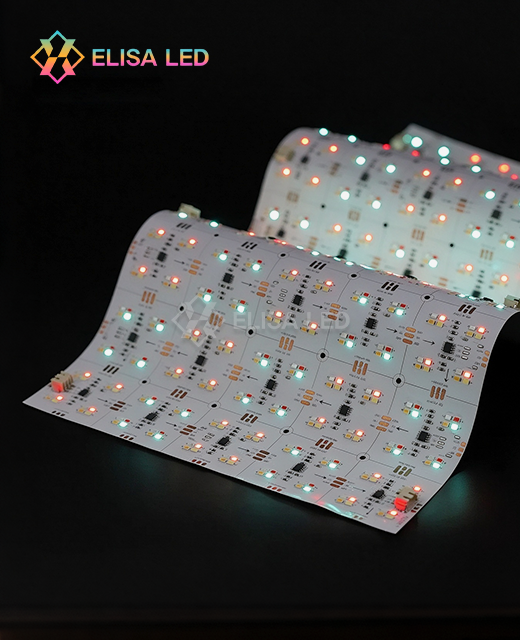
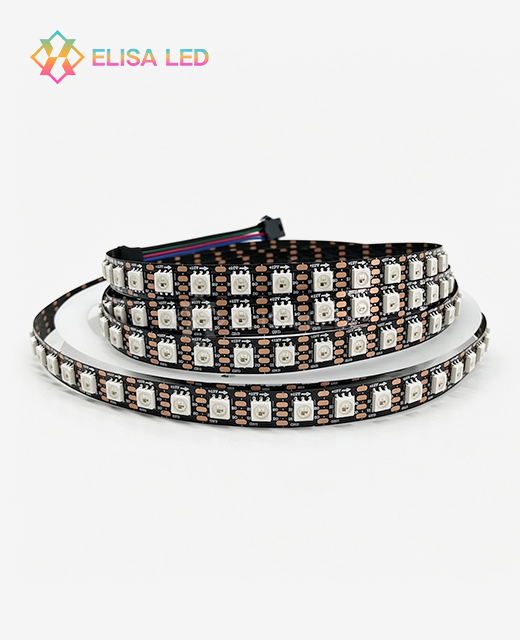
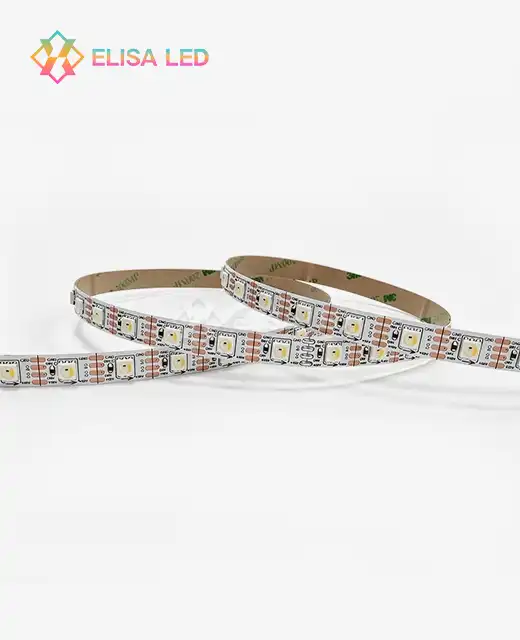
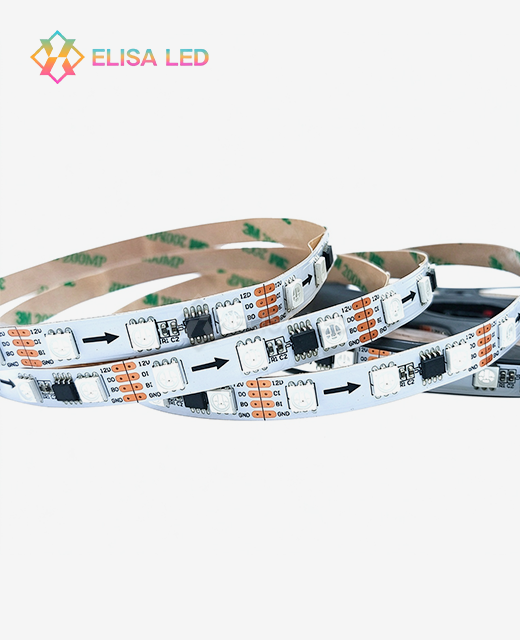
When designing addressable LED projects, choosing the right driver IC is one of the most important decisions you will make. Two popular options from WorldSemi are the WS2815 and the WS2818B. Both operate at DC12V and feature breakpoint continuation, making them more reliable than the older 5V WS2812B. However, they are not interchangeable.
This article from Elisa LED breaks down the real technical differences so you can choose the right chip for your application.
| Feature | WS2815 | WS2818B |
|---|---|---|
| Voltage | DC12V | DC12V |
| Package Type | Built-in IC (inside 5050 LED) | External IC (SOP8 package) |
| Individually Addressable | Yes (1 LED = 1 pixel) | No (1 IC controls 3 or 6 LEDs) |
| Breakpoint Continuation | Yes (dual signal) | Yes (dual signal) |
| PWM Frequency | 4kHz | 4kHz |
| Gray Scale | 256 levels | 256 levels |
| Data Rate | 800Kbps | 800Kbps |
| Typical Application | High-resolution pixel displays | Cost-effective long runs |
The most important distinction is where the driver IC is located.
WS2815 is an integrated solution. The control circuit and RGB chip are packaged together inside a single 5050 LED component. Every LED is a complete, self-contained pixel.
WS2818B is a separate driver IC. It comes in an SOP8 package and is soldered onto the PCB alongside the LEDs. One WS2818B chip controls 3 LEDs at 12V or 6 LEDs at 24V.
| Aspect | WS2815 | WS2818B |
|---|---|---|
| Pixel Resolution | Highest (every LED is addressable) | Lower (pixels are grouped in 3s or 6s) |
| PCB Complexity | Simple (one component per pixel) | More complex (IC + LEDs) |
| Animation Smoothness | Ultra-smooth, per-LED control | Smoother than WS2811, but less detailed |
| Best For | Detailed graphics, close viewing | Long runs, distance viewing, budget projects |
Key Takeaway: If you need true per-LED control for intricate animations, WS2815 is the clear choice. If you need cost-effective long runs where viewers are far away, WS2818B delivers excellent value.
Both chips share several critical advantages over the older WS2812B.
At 12V, the current draw is roughly one-third of a 5V system for the same power. This dramatically reduces voltage drop over long cable runs.
| Voltage | Typical Max Run (without injection) |
|---|---|
| 5V (WS2812B) | ~5 meters |
| 12V (WS2815 / WS2818B) | 10–15+ meters |
Both chips feature dual signal lines. If one LED (WS2815) or one IC (WS2818B) fails, the signal bypasses the failure and continues downstream.
This is a massive reliability improvement over single-signal chips like WS2812B.
Both chips offer a 4kHz PWM refresh rate, providing:
Flicker-free performance for most video recording
Smooth dimming and color transitions
You need true per-LED addressability for detailed animations, text, or video displays
Your viewing distance is close (within a few meters)
You want the simplest PCB design (no external ICs to place)
Your budget allows for a premium chip
You need long runs with minimal power injection (12V or 24V operation)
Viewers will be at a distance where grouped pixels are not noticeable
You need a fault-tolerant design for hard-to-reach installations
Cost is a primary concern for large-scale projects
| WS2815 | WS2818B | |
|---|---|---|
| Addressability | 1 LED = 1 pixel | 1 IC = 3 or 6 LEDs |
| Resolution | Highest | Good for distance viewing |
| Cost | Higher | Lower |
| Reliability | Excellent (built-in) | Excellent (external IC) |
| Best For | High-detail displays | Long runs, budget projects |
The bottom line: There is no “better” chip—only the right chip for your specific project. WS2815 excels when pixel-level detail matters. WS2818B delivers exceptional value for long-distance, fault-tolerant installations.
The main difference is the IC packaging. WS2815 uses a built-in IC inside each 5050 LED, so every LED is individually addressable. WS2818B uses an external SOP8 driver IC, and one IC controls 3 LEDs at 12V or 6 LEDs at 24V.
No. Although both operate at DC12V and support breakpoint continuation, they have different IC architectures, PCB layouts, and addressing methods. They are not direct replacements for each other.
WS2815 is better for high-resolution displays because each LED is a separate pixel. This provides smoother animations and more detailed graphics, especially for close-viewing applications.
WS2818B is generally more cost-effective for long runs because one IC controls multiple LEDs. It is ideal for large-scale installations where viewers are farther away and grouped pixels are not noticeable.
Yes. Both chips feature dual signal lines and breakpoint continuation. If one LED or IC fails, the signal can bypass the failure and continue to the downstream LEDs, improving reliability.
In most cases, no. They use different driver architectures and addressing schemes. Mixing them in the same signal chain is not recommended unless the control system is specifically designed for it.
Both are designed for DC12V operation. For 24V versions of WS2818B-based products, use a 24V power supply. Always match the power supply voltage to the LED strip specification and allow enough current capacity for your project.
It depends on your project. Elisa LED recommends WS2815 for high-detail, close-viewing pixel displays and WS2818B for cost-effective, long-distance, fault-tolerant installations. Contact Elisa LED with your project requirements, and we will recommend the optimal solution.
At Elisa LED, we offer LED strips based on WS2815, WS2818B, and other popular ICs. Tell us your project requirements, and we will recommend the optimal solution.
Contact Elisa LED today for samples, technical support, or a quote.