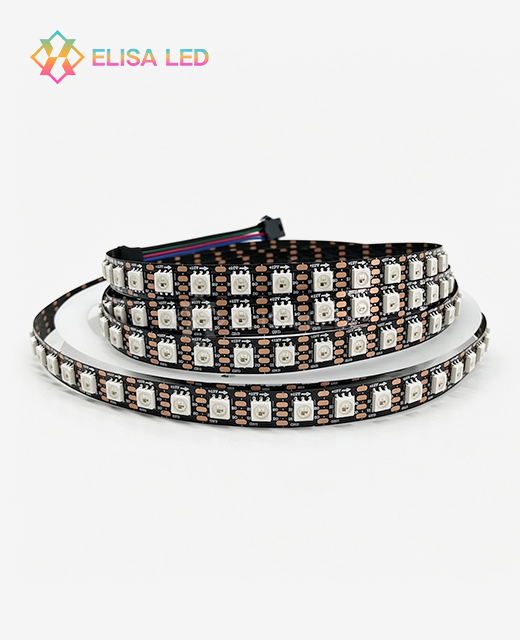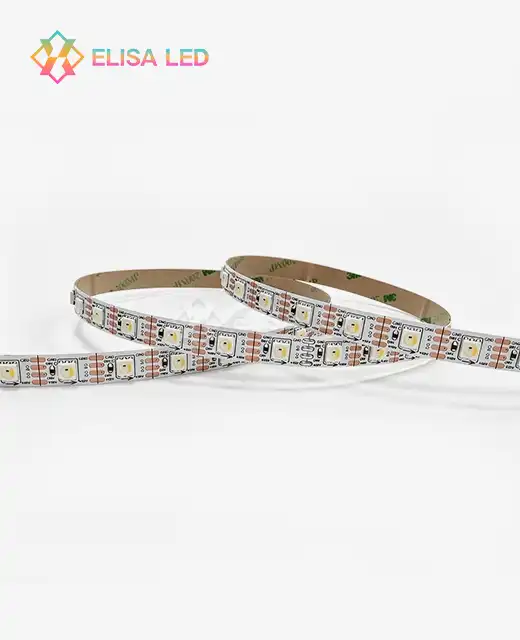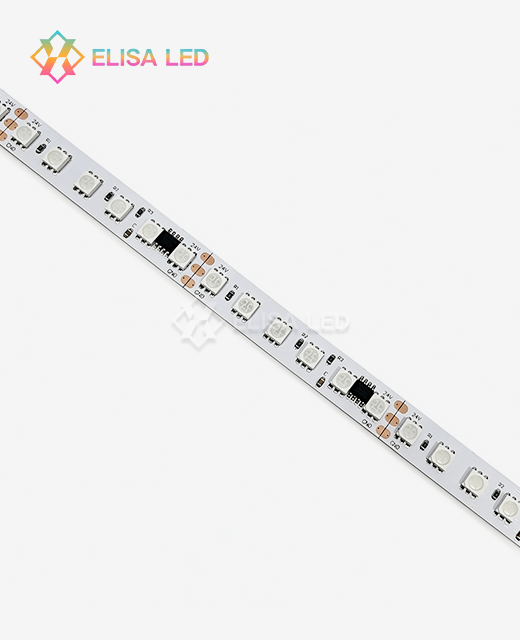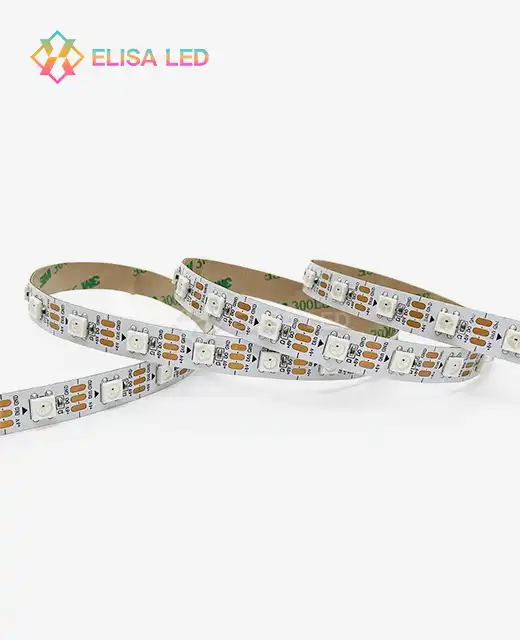
60LEDs/m SK6812 5050 RGB
Brightness: 504lm/m
MOQ: 5M
Lead Time: 5-7days
PCB width: 10mm
IP Rating: IP20/IP65/IP67/IP68
MOQ: 5M
Lead Time: 5-7days
PCB width: 10mm
IP Rating: IP20/IP65/IP67/IP68
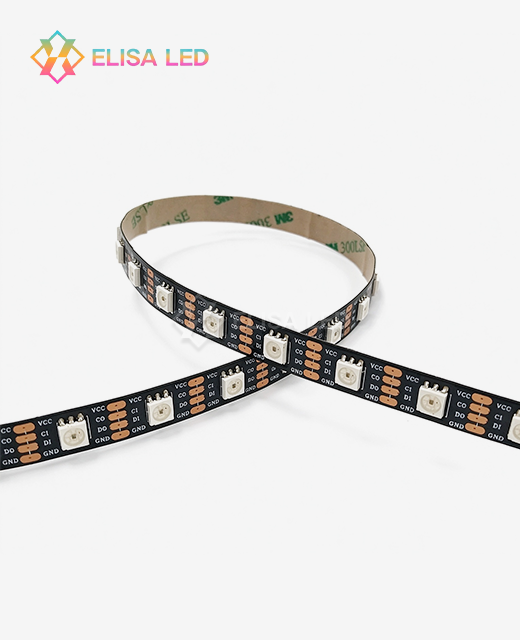
60LEDs/m SK6812 5050 RGB strip from ElisaLED puts 60 individually addressable pixels per meter on a 10mm flexible PCB, running at DC 5V with 14.4W/m power draw and 504 lm/m output. The on-board SK6812 IC shapes signals at each node, and 256 greyscale levels per channel let you to create over 16 million colour combinations without any external decoders. IP ratings from IP20 to IP68 make them suitable for indoor or outdoor use scenarios.

The SK6812 is a one-wire Digital Addressable LED strip with each 5050 SMD package including the RGB chip and control IC. Each pixel is controlled individually, yet all pixels share one data line at 800Kbps. This gives you per-pixel colour management without any extra decoders or controller boards.
The SK6812 IC is driven at a PWM frequency of ~1.2 kHz. That increased refresh rate also helps decrease the flutter seen in video recordings compared to previous single wire IC designs, making it a viable alternative for camera facing setups.
This strip sits between decorative accent lighting and professional architectural or stage work — precise enough for pixel-mapped effects, robust enough for commercial-grade environments.
| Parameter | Value |
|---|---|
| Part Number | XXA-STRIP-60D5050RGB-SK6812 |
| LED Density | 60 LEDs/m |
| LED Package | 5050 SMD |
| IC | SK6812 |
| Voltage | DC 5V |
| Power Consumption | 14.4 W/m |
| Brightness | 504 lm/m |
| PCB Width | 10 mm |
| Pitch/mm | 16.67 |
| Grayscale | 256 levels per channel |
| Data Speed | 800 Kbps |
| PWM Frequency | ~1.2 kHz |
| IP Rating | IP20 / IP65 / IP67 / IP68 |
| Warranty | 2 years |
Key Technical Advantages
The SK6812 IC has an internal signal reshaping circuit, which re-generates the data signal at each pixel node. This eliminates the cumulative signal distortion that causes colour mistakes or flicker on lesser quality addressable strips when operated continuously for lengthy runs.
The FPCB is made with 2 oz or 3 oz copper which helps with heat distribution along the strip and leads to more consistent colour output over time. The SK6812 LED package is rated for an average lifetime of 50,000 hours under regular working circumstances.
Each pixel on this strip can be cut individually at every LED interval. Unlike 12V or 24V strips that require cutting every 3 or 6 LEDs, single-pixel cut points make it easier to fit the strip into non-linear geometries and custom channel profiles without wasted segments.
Architectural Cove and Profile Lighting
At 60 LEDs per meter, the pixel density produces a smooth, continuous linear glow inside frosted aluminum profiles. Even on tight-radius curves, pixel spacing is close enough to avoid visible dark spots between LEDs.
Stage and Touring Productions
The SK6812 protocol maintains signal integrity across long data runs in high-EMI environments such as live concert stages and festival rigs. Signal reshaping at each IC node reduces data corruption over distance without requiring additional amplifiers at short intervals.
Commercial Display and Interactive Environments
Individual pixel mapping makes this strip for 60LEDs/m SK6812 5050 RGB suitable for retail experience zones, interactive display walls, and high-end PC builds where reactive ambient lighting requires per-pixel control at the software level.

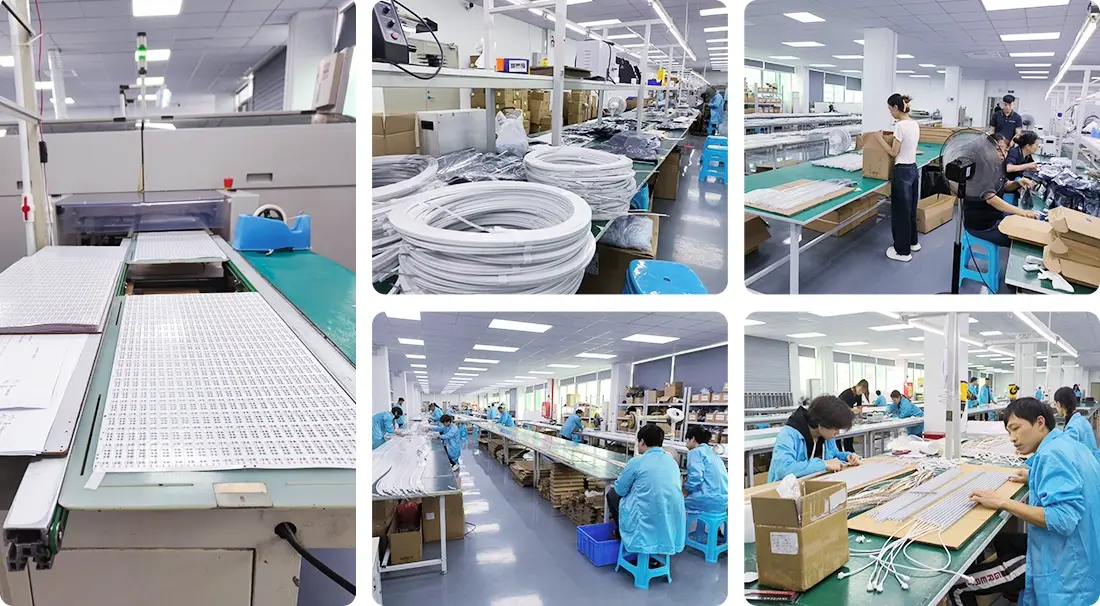
ElisaLED applies a multi-stage QC process to every production batch:

Voltage regulation matters more at 5V than at 12V or 24V. This strip requires a stable, regulated 5V DC supply. Connecting a 12V supply will destroy the SK6812 IC. Size your power supply at 20–25% above calculated load to allow headroom.
Plan for voltage drop on runs longer than 2.5 meters. The 5V architecture is more sensitive to voltage drop than higher-voltage strips. Inject power at both ends of any run and consider mid-point injection every 2.5–3 meters on extended installations to keep color uniform across the full length.
For data runs longer than ~5 meters, use a signal repeater. Beyond that, the signal integrity might decline if not amplified. A null-pixel injector or signal repeater using insulated twisted pair cable extends reliable data transmission on bigger installations.
Compatibility with controllers is easy. Timing for SK6812 is quite similar to WS2812B. Works with FastLED, NeoPixel and most popular addressable LED libraries without protocol modifications.

ElisaLED enables OEM & ODM manufacture on this series. Options for customisation include PCB design, LED chip, IP rating, wiring options, reel length and package type. Get in touch with the team with your project needs to explore feasibility and lead times.
Q:What's the difference between SK6812 and WS2812B?
A: Both have one data line and both work with FastLED and NeoPixel libraries. The SK6812 has a higher PWM frequency (~ 1.2 kHz) which decreases flutter when seen on film. Also SK6812 is available in RGBW and WWA which WS2812B does not give.
Q:What's the difference between SK6812 RGBW and SK6812 WWA?
A. SK6812 RGBW adds a white channel in addition to the RGB to make a real white light with complete colour effects. SK6812 WWA allows adjustable white illumination with no colour gamut need using warm white, cool white and amber channels.
Q: Why pick 60 LEDs/m over 30 LEDs/m?
A: Higher pixel density results in more fluid animation transition, and removes dark spots which may be seen with 30 LEDs/m, inside channels of shallow profile where the diffusion distance is restricted.
Q: What should I look for when buying a digital LED strip?
A: The major considerations are IC protocol type, LED density, voltage & power supply needs, colour or white channel arrangement, refresh rate, signal stability across your run length, controller compatibility, IP rating and the cut interval your installation geometry demands.
Q: When would you want to use WS2815 or WS2813 instead of SK6812?
A: WS2815 and WS2813 have two data lines. If one LED in the chain goes bad, the backup data connection allows the remainder of the strip to work. That redundancy is worth considering for big permanent installations where a single point of failure would entail a service call to rectify.
Q:When does SK9822 or APA102C make more sense than SK6812?
A:SK9822 and APA102C use separate data and clock lines, which allows much higher refresh rates and smoother PWM dimming. They are better suited to video playback walls and high-refresh display applications where the single-wire protocol's refresh rate becomes a limiting factor.
Have a project requirement for 60LEDs/m SK6812 5050 RGB? Send your inquiry to inquiry@elisaled.com and the ElisaLED team will get back to you.